
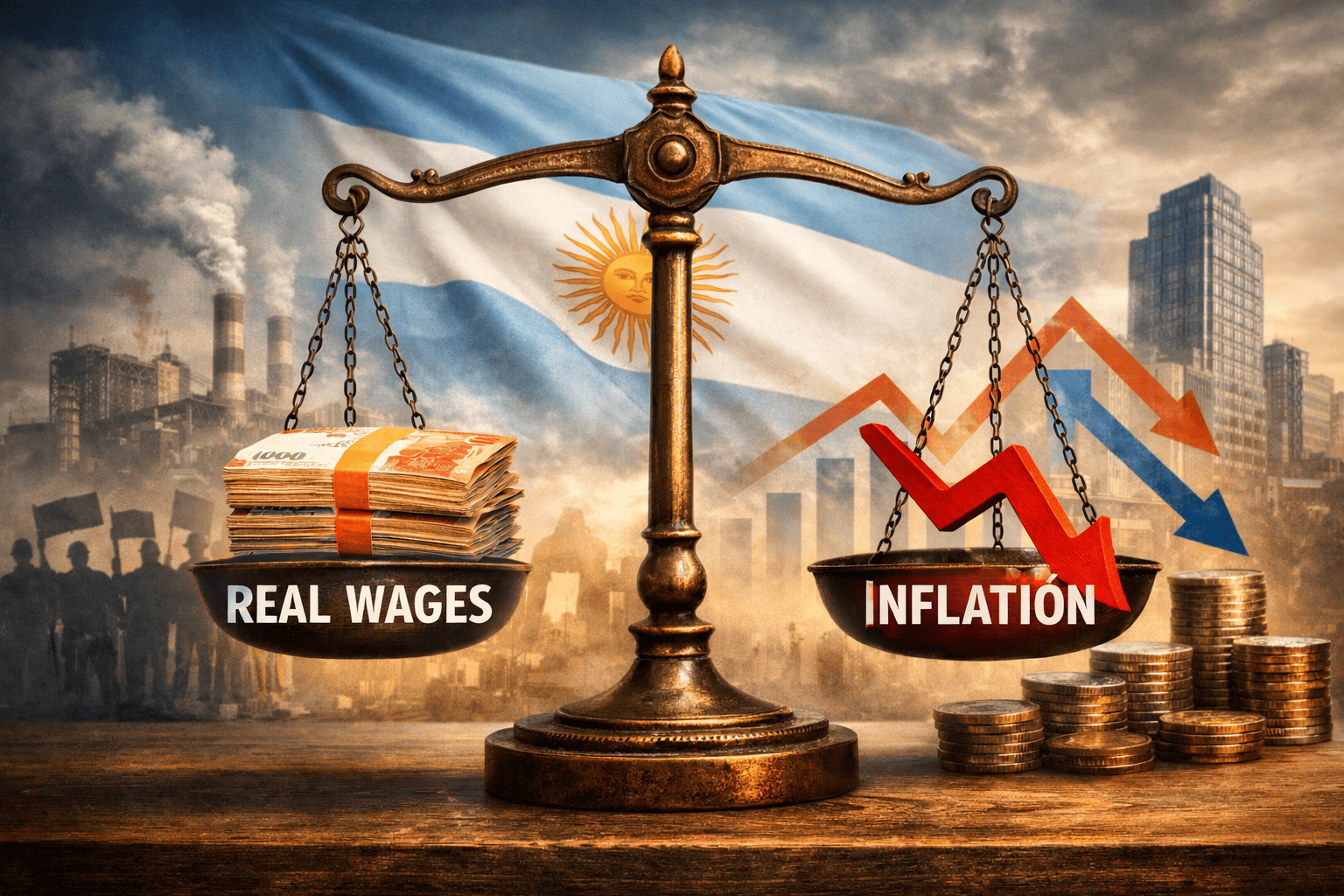
When prices rise faster than wages, purchasing power falls. This observation, while obvious, does not exhaust the problem. What truly matters is understanding why this dynamic repeats itself systematically in Argentina, even during periods of economic growth or temporary stabilization.
Behind the statistics lies a fundamental theoretical dispute: how are wages actually determined in an economy? Are they automatically set by “the market,” or are they the result of a power struggle among unequal actors? Is inflation the cause of wage problems—or a consequence of them?
This article examines these questions by combining economic theory, empirical evidence, and historical experience. Argentina’s trajectory, together with successful episodes such as Brazil’s Real Plan and Israel’s stabilization in the 1980s, offers crucial lessons about the links among inflation, wages, and the governance of distributive conflict.
1. Inflation as a Distributive Battlefield
Wages are not simply a price emerging from the intersection of labor supply and demand. They are the visible outcome of an institutionalized conflict among actors with unequal power: firms that set prices, workers who negotiate nominal wages, and a state that arbitrates (or fails to arbitrate) that conflict.
From Latin American structuralist and post-Keynesian perspectives, inflation performs a specific function in this conflict: it redistributes income in an opaque manner. While prices can adjust almost immediately to shocks (devaluation, cost increases, expectations), wages are tied to slower institutional dynamics—contracts, periodic collective bargaining rounds, and negotiation calendars.
Key Concept: Mark-up Theory
Firms do not set prices by simply adding costs and accepting any margin. Following Michal Kalecki, firms add a profit margin (mark-up) that depends on market power. In oligopolistic or highly concentrated contexts, this margin can be substantial and relatively stable.
Simplified formula: Price = Costs × (1 + mark-up)
When costs rise (wages, imported inputs, taxes), firms pass those increases to prices and preserve their margin. This can generate inflation even without uncontrolled monetary expansion.
The “Liquidity” (Erosion) Mechanism
Consider the following scenario—typical in Argentina over recent decades:
- January: A 30% annual wage increase is negotiated (about 2.5% monthly).
- February–March: The exchange rate jumps by 40%.
- April: Prices have already risen 35%, but wages have increased only 7.5%.
- Result: Purchasing power falls until the next bargaining round.
This “institutional lag” is not neutral. Roberto Frenkel showed that these temporal asymmetries can generate involuntary transfers from labor to sectors with greater price-setting power—large firms, price leaders, and the state via the inflation tax.
The 2001–2002 Crisis as a Laboratory
The 2001–2002 crisis is an extreme case of adjustment through inflation. Between December 2001 and December 2002:
- Real wages fell by 27% (INDEC).
- The Gini coefficient increased from 0.502 to 0.534.
- Poverty jumped from 38% to 58% of the population.
- Business profitability in tradable sectors doubled.
This “disorderly adjustment” allowed fiscal accounts and corporate margins to recover rapidly—but at the cost of an unprecedented income transfer from labor to capital. The subsequent recovery (2003–2007) did not fully reverse this regressive redistribution.
From this viewpoint, inflation appears as a regressive adjustment tool: macroeconomically effective for resolving imbalances, but socially costly and politically delegitimizing.
2. The Liberal Reply: Productivity as a Structural Limit
Structuralist readings, argue neoclassical and monetarist economists, confuse symptoms with underlying causes. They focus on inflation-driven erosion but overlook the key question: why are wages low in the first place?
According to marginal productivity theory, the equilibrium real wage is determined not by inflation but by the economy’s ability to generate value per hour worked. An economy with low output per worker can only sustain low wages. Inflation does not explain the level; it merely makes it more volatile.
The Strong Version of the Argument
If policymakers attempt to raise wages above what productivity allows through:
- Nominal wage decrees
- Automatic indexation
- Dismissal restrictions that raise hiring costs
…the outcome will likely be some combination of:
- Higher inflation (firms pass cost increases to prices)
- Higher unemployment (especially for youth and low-skilled workers)
- Greater informality (firms evade labor costs)
- Lower investment (uncertainty about future costs)
The Convertibility “Experiment”
Argentina offers a near-controlled experiment. During 1991–2001:
- Inflation was eliminated (even deflation occurred in 1999–2001).
- Nominal stability was sustained for a decade.
- Yet average real wages in 2001 were similar to 1991.
- Meanwhile, unemployment rose from 6% to 18% and informality surged.
Why didn’t stability translate into sustained wage gains? Because it coexisted with:
- An overvalued exchange rate that harmed domestic industry
- Trade opening without a reconversion strategy
- Labor reforms that weakened collective bargaining
- A reduced state role as coordinator of industrial transformation
Nuanced neoclassical conclusion: Controlling inflation is a necessary condition for real-wage stability, but not sufficient for sustained growth. Without capital accumulation, technological innovation, and organizational improvements that raise productivity, wage gains will be temporary or illusory.
3. The Argentine Dilemma: Between Monetary Discipline and the Productive Constraint
The tension between these views is not merely academic. It shapes concrete policy choices with real consequences for millions.
Path A: Stabilize First, Distribute Later
Priority: eliminate inflation through strict monetary and fiscal discipline.
Tools: exchange-rate anchor or strict inflation targeting; primary fiscal surplus; credit restraint.
Risk: prolonged recession, higher unemployment, social conflict.
Historical reference: Convertibility (1991–2001) — successful at stabilization, unsuccessful at sustained development.
Path B: Distribute to Grow
Priority: sustain demand and employment as engines of investment.
Tools: expansive wage policy; countercyclical public spending; competitive exchange rate.
Risk: inflationary spiral, capital flight, balance-of-payments crisis.
Historical reference: Argentina (2007–2015) — stronger employment performance, weaker nominal stability.
Path C: Institutional Coordination
Priority: a social agreement on income distribution plus active industrial policy.
Tools: income pacts; sectoral dialogue tables; strategic public investment.
Challenge: requires trust, strong institutions, and a long-term horizon.
International references: Israel (1985), Brazil’s Real Plan — successful in both stability and distributive outcomes.
Argentina has historically oscillated between A and B without consolidating C. The central question is whether current political and institutional conditions allow building that third path.
4. Three Stabilization Paths: International Comparison
| Dimension | Argentina (Convertibility, 1991) | Brazil (Real Plan, 1994) | Israel (1985) |
|---|---|---|---|
| Initial inflation | 2,314% annual | 2,406% annual | 445% annual |
| Core mechanism | Fixed exchange rate + privatizations | Deindexation + new currency | Negotiated income policy |
| Real wages (after 5 years) | Stagnant | +35% (lower-income groups) | +15% |
| Formal employment | -18% | +12% | +8% |
| Sustainability | Collapsed in 2001 | Sustained 30+ years | Sustained 40+ years |
4.1 Brazil: When Stabilization Means Redistribution
The Real Plan, implemented in 1994 under Fernando Henrique Cardoso’s leadership, is among Latin America’s most successful stabilization experiences. Its design included three key pillars:
- Gradual deindexation: a unit of account (URV) helped coordinate expectations during the transition to a new currency.
- Elimination of the inflation tax: stabilization disproportionately benefited low-income households with fewer inflation-hedging tools.
- Idle capacity: Brazil could absorb higher consumption without immediate inflationary bottlenecks.
The result was a rapid recovery of purchasing power, especially in the lowest deciles. The real minimum wage rose by more than 35% in the first five years after stabilization.
Importantly, Brazil’s success cannot be attributed only to monetary stabilization. It was supported by an institutional design that avoided a deep demand contraction and by a diversified productive structure capable of responding to higher consumption.
4.2 Israel: Coordination as Political Technology
In 1985, Israel faced a hyperinflationary process that threatened to destroy its economic and social fabric. Inflation reached 445% annually and expectations were unanchored.
Israel’s stabilization had distinctive features:
- Explicit income policy: the government negotiated with the Histadrut union federation a temporary suspension of wage indexation. The initial real-wage decline was acknowledged and negotiated, rather than imposed implicitly through inflation.
- Shared sacrifice: wage restraint was combined with spending cuts and tax increases, spreading adjustment costs across social groups.
- Productive transformation horizon: stabilization was complemented by policies supporting high-tech development, strengthening long-term productivity and wages.
- Scale and cohesion: Israel’s smaller, more cohesive economy facilitated coordination among actors.
This case challenges the idea that inflation is the sole enemy of wages. It suggests that how distributive conflict is governed during the transition to stability is as important as stabilization itself.
4.3 Argentina: The Mirage of Stability Without Transformation
Convertibility eliminated inflation dramatically—from 2,314% in 1990 to under 1% by 1996. Yet it did not generate sustained wage improvements or productive transformation.
Strengths:
- Rapid disinflation
- Restored confidence in the currency
- Stabilized relative prices
Structural weaknesses:
- Destruction of productive chains due to opening without reconversion
- Overvalued exchange rate undermining industry
- Growing dependence on external financing
- Rigid exchange-rate regime preventing adjustment to external shocks
The outcome was jobless growth for much of the decade, followed by a devastating crisis. The lesson is clear: nominal stabilization without productive transformation creates a fragile and socially unsustainable equilibrium.
5. Lessons for Argentina’s Contemporary Debate
First: Inflation is incompatible with stable wages
High and persistent inflation is incompatible with stable and rising real wages. There is no successful case of sustained improvement in labor income under two- or three-digit inflation. Stabilization is necessary.
Second: Stabilization does not automatically improve wages
Stabilization alone can coexist with distributive stagnation (Argentina, 1991–2001), pro-capital growth, or distributive gains (Brazil after 1994). Outcomes depend on institutional design, industrial policy, and social coalitions.
Third: Adjustment governance determines sustainability
The way distributive conflict is governed during the transition matters as much as stabilization itself. Disorderly adjustments impose high social costs and leave durable distributive scars; negotiated coordination spreads costs more equitably and builds sustainable consensus.
6. Final Reflection: Building Stability with Transformation
After four decades of high inflation, multiple crises, and repeated stabilization failures, Argentina faces a familiar crossroads: how to stabilize without reproducing the mistakes of the 1990s? How to avoid turning stabilization into wage stagnation?
Successful international experiences suggest there are no shortcuts. A delicate balance is required among:
- Credible macroeconomic discipline (sustainable fiscal consistency; clear monetary rules; exchange-rate management that avoids overvaluation and extreme volatility)
- Industrial policy that raises productivity (investment in high value-added tradables; technological capabilities; human capital; smart global integration)
- Labor institutions that coordinate without rigidifying (sectoral bargaining aligned with productivity; adjustment flexibility without mass precarization; protecting workers more than specific jobs)
- Social agreements that distribute costs fairly (explicit recognition of necessary sacrifices; negotiated burden sharing; credible and verifiable recovery horizon)
None of these conditions is impossible. But all require something Argentina has repeatedly lacked: a state-policy horizon that transcends electoral cycles and ideological polarization.
The challenge is not technical but political: building coalitions capable of sustaining transformations that take years to mature in a context of urgent social needs. Without that institutional base, any stabilization will once again be temporary.
The open question is whether Argentine society—after decades of failed experiments—is willing to build the consensus needed for a different path: one that avoids the disorderly adjustment of 2002 and the stability-without-transformation illusion of the 1990s, and instead combines stability with productive development and a genuine improvement in living standards.
References
Structuralist and distributive conflict theory
- Kalecki, M. (1971). Selected Essays on the Dynamics of the Capitalist Economy. Cambridge University Press.
- Prebisch, R. (1981). Peripheral Capitalism: Crisis and Transformation. Fondo de Cultura Económica.
- Taylor, L. (1983). Structuralist Macroeconomics. Basic Books.
Argentina: inflation, wages, and distribution
- Basualdo, E. (2010). Studies in Argentine Economic History. Siglo XXI.
- Frenkel, R. (2004). Real Exchange Rate and Employment in Argentina, Brazil, Chile and Mexico. CEDES Working Paper.
- Frenkel, R., & Rapetti, M. (2007). Exchange-rate and monetary policy after the collapse of convertibility. CEDES.
- Gerchunoff, P., & Llach, L. (2003). The Cycle of Illusion and Disenchantment. Ariel.
- Heymann, D. (2000). Stabilization policies and real wages in Latin America. ECLAC.
Neoclassical productivity and growth
- Solow, R. (1956). “A contribution to the theory of economic growth.” Quarterly Journal of Economics, 70(1), 65–94.
- Lucas, R. (1988). “On the mechanics of economic development.” Journal of Monetary Economics, 22(1), 3–42.
International stabilization experiences
- Bacha, E. (1997). “Plano Real: uma avaliação.” Revista de Economia Política, 17(4), 62–76.
- Bruno, M., & Fischer, S. (1990). “Seigniorage, Operating Rules and the High Inflation Trap.” Quarterly Journal of Economics, 105(2), 353–374.
- Dornbusch, R., & Simonsen, M. (1987). “Inflation Stabilization with Incomes Policy Support.” Economic Policy, 2(4), 99–121.
Statistical sources
- INDEC (various years). Wage Index and Consumer Price Index.
- CIFRA-CTA (various years). Reports on income distribution and labor markets.
- FIEL (various years). Indicators on labor costs, productivity, and competitiveness.
- IIEP-UBA/CONICET (various years). Reports on minimum wage, employment, and income.
Leave a Reply